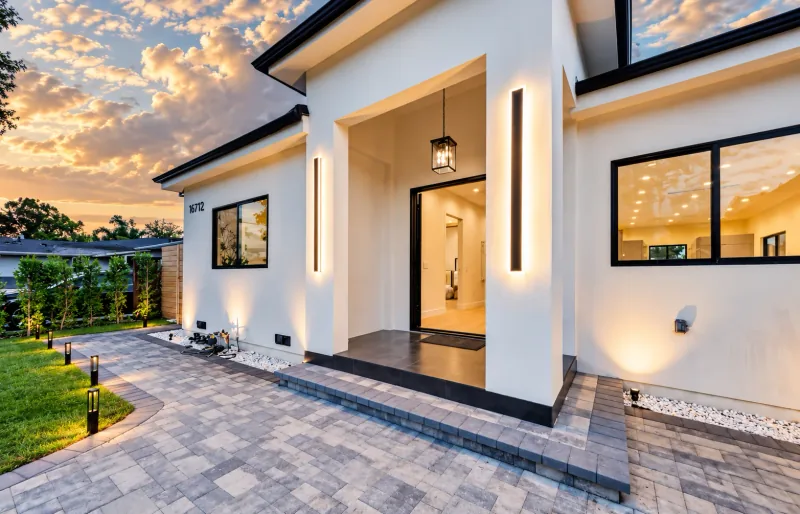
1. Match the contractor’s experience to your project
Ask to see completed work that resembles the building you are planning. An interior renovation, a garage conversion, a detached ADU and a ground-up custom home involve different starting conditions. Look beyond the finished kitchen: ask which parts of the project the contractor actually handled, what the site required and how the work was coordinated.
Dream Construction’s selected local examples include a 1,200-square-foot two-story ADU in Sun Valley, another 1,200-square-foot ADU in North Hollywood, and a 2,222-square-foot custom home in Granada Hills completed in 2026. These galleries show examples from our wider portfolio.
2. How to check a California contractor’s license
Start with the official CSLB License Check, rather than a directory badge. Search by license number or business name. Dream Construction Inc.’s license number is 1051776; use the same checks when comparing any builder.
- Match the business name and address in the result to the company on your proposal.
- Review the current license status, classification and expiration information. Resolve any mismatch before signing.
- Read the record’s bond, workers’ compensation and public disclosure information, including any explanatory notes.
- Request current insurance documentation and verify coverage with the listed carrier or agent. A license number alone does not describe all insurance coverage.
- Save the date and result of your check, and confirm the record again before entering an agreement.
CSLB recommends comparing at least three written bids based on the same plans, specifications and scope. Check references too: ask previous clients how changes, communication and completion items were handled. Ask permission before arranging a project visit.
3. Compare the same written scope
Two proposals can describe the same home while including different work. Give each builder the same available drawings and selection information. Ask for unclear items to be resolved in writing before comparing the proposals.
- Planning and design: identify who prepares or coordinates drawings, engineering and revisions.
- Permits: identify who submits documents, responds to comments and tracks outstanding approvals.
- Site work: discuss access, demolition, foundation work and utility connections for the actual property.
- Building and finishes: clarify systems, cabinets, appliances, surfaces and owner-supplied items.
- Changes and allowances: ask how unresolved selections and requested changes are documented.
- Completion: clarify final inspections, walkthrough items and the handover documents included.
Make a comparison sheet with one row per work item and one column per builder. Mark each item Included, Excluded, Allowance or Owner responsibility, then record the drawing revision and unresolved assumptions. Ask bidders to clarify blank cells. A short line reading ‘site work’ is not enough to compare trenching, connections and surface restoration.
Questions to ask an ADU builder before choosing a team
Use the first meeting to understand how the proposed unit will fit the property and who will resolve open questions. These are useful questions whether you need help from the first concept or already have approved drawings.
- What has been checked on site, and what still depends on a survey, investigation or agency response?
- Which utility connections, service assessments and work to the main home are included?
- For a conversion, which existing walls, slab and roof are assumed to remain, and how will those assumptions be checked?
- For a two-story design, where will the stairs, entrance and household circulation fit?
- Who is my day-to-day contact, and who coordinates inspections and trade work?
- How will I review changes and their effect on the agreed scope and schedule before work proceeds?
4. Separate planning time from construction time
Ask where the proposed schedule begins. Design, plan review, permit issuance and construction are separate stages; a construction duration does not describe the whole journey from the first idea. Our Sun Valley and North Hollywood ADUs took six and five months to build respectively. The Granada Hills custom home took six months to construct. These completed examples are not a forecast for another property.
Confirm which authority handles your property before assuming a particular approval process applies. Locations across the Valley and Greater Los Angeles may fall under different jurisdictions. For a City of Los Angeles property, LADBS provides plan review, permit and inspection resources. Your team should explain what is already approved and what remains before construction can start.
5. Prepare a useful first conversation
Bring your property location, proposed use, available plans, approval status and the decisions you have already made. Describe any access concerns and your preferred timing. If plans are not started, explain the spaces and priorities that matter most to your household.
Dream Construction coordinates planning, design, permits and construction for ADUs and custom homes across Los Angeles and the San Fernando Valley. We can discuss your current stage and define the work ahead. Choose the relevant service below to see completed projects and request a consultation.